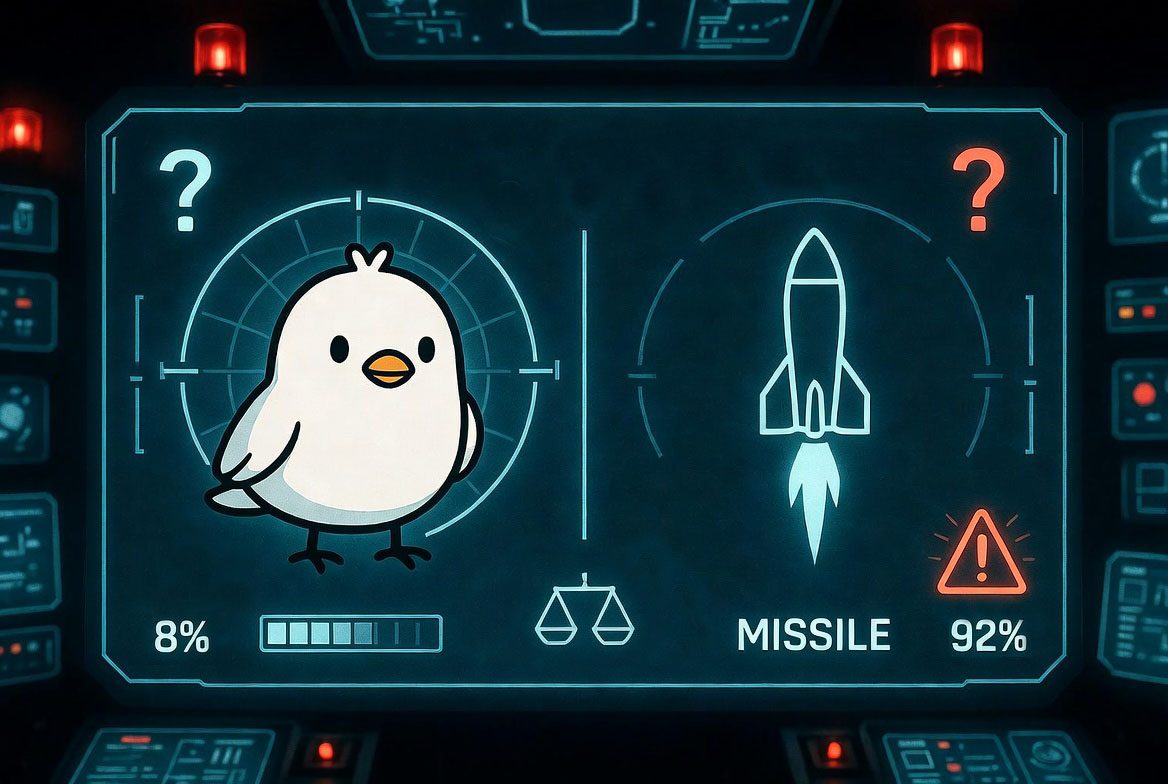
A Lens Inspired By Detection Theory
Suppose you are told to construct an algorithm that will automatically detect missiles flying over the Pacific Ocean so that a missile defense system can shoot them down before blowing up Seattle or Los Angeles. If your algorithm is too loose, false positives ensue – Tomahawk missiles end up blowing seagulls out of the sky because it can’t distinguish the signal (the nuclear missile) from the noise (jets, birds, drones, etc.). If your algorithm is too strict, that leads to false negatives – missiles get by, and millions of people suffer a nuclear holocaust.
False negatives in this situation are magnitudes more catastrophic than false positives, so whatever solution is proposed will seek to minimize false negatives at the expense of allowing potentially many false positives. The solution requires accepting the terrible optics of exploding birds. The optimal algorithm will be incredibly loose – but not 100% loose – since we also can’t be shooting passenger planes out of the sky.
Whether we realize it or not, any time we find ourselves in an environment of “noise” of any kind and we’re given a task to sort through that noise to find the “signal,” we are dealing with detection theory. In addition to the missile detection example, another classic example would be spam filtration. This involves detecting junk message “signals” among all the “noise” of legitimate e-mail and deciding how many spam emails are acceptable to receive (false negatives) in order to ensure no legitimate emails are lost (far worse false positives). Detection theory provides a framework to set up an optimal, but never perfect, cost-benefit analysis framework to arrive at the best (or least damaging) solution.
Any time we can look at something through the lens of detection theory, two things are involved: algorithm and threshold. The algorithm represents what factors are considered, and the threshold represents subjective lines that are drawn based on human values within each of those factors.
Applications Are All Around Us
The world becomes super fascinating when we start seeing detection theory in all the places it truly exists. The super technically-minded might object to some examples here, but the point of this article isn’t to be scientifically and mathematically perfect about detection theory’s applications, but instead to simply offer an analogous mental framework to use for so many world phenomena we encounter. (Feel free to cherry pick which of these examples you choose to read, or read all of them if desired.)
- The guilty: The U.S. justice system seeks to find the truly guilty person (signal), ideally acquitting innocent people (noise). The false positive sends innocent people to jail, while the false negative lets criminals walk free. Our society has little stomach for convicting the innocent, so our justice system uses a strict detection algorithm (“innocent until proven guilty,” “beyond all reasonable doubt,” insanity pleas, getting off on technicalities, etc.).
- Eradicating pests: Pest control companies are always seeking to find ways to invent new traps, poisons, etc. that apply only to the targeted animal (the “signal,” such as rats) and that don’t pose any danger to other animals, humans, plants, etc. (the noise, such as your pet dog). The false positive would result in dead pets, while the false negative results in a failure to address the pest population, so the pest control signal detection “algorithm” for each targeted pest is fairly strict.
- One True Religion: Billions of people have sought to find “the one true religion” (the signal) among noise (all other religions). Everyone has their own detection algorithm. We can imagine the absurdly loose algorithm: “I came to a traffic light while driving, and when I saw the green light, I knew it was God telling me I should start attending the church located at that intersection.” We can also imagine a tight algorithm that is equally absurd: “Not once have I ever heard any voice booming out of the clouds telling me to believe in such-and-such a religion, therefore I’m an atheist.” Too loose an algorithm, and we potentially select a false religion (false positive). Too tight, and no religion, even the one true religion, could ever be good enough to satisfy our requirements (our evaluation of the “one true religion” results in a false negative).
- Answered Prayer: If intercessory prayer is signal and the unanswered prayer is noise, detection of answered prayers should require a very strict algorithm and very high threshold, and the word “very” in this sentence is an understatement. If you flip a coin a trillion times, you will witness 40 heads in a row and also 40 tails in a row. You will even witness the coin balancing on its edge. There are countless quadrillions of things that happen to you and in the world while you are alive, and so it is inevitable that you will witness coincidences that seem impossible to produce without divine intervention, such as the job offer that comes 10 minutes after you are fired. Ironically, a life void of any coincidences at all would be such a statistical anomaly as to strongly suggest an interceding God.
- Insurance fraud: Insurance companies are forced to be extremely vigilant to protect against insurance fraud. They develop criteria that must be met in order to identify a person trying to scam an insurance company out of money with a false claim (the signal). If their criteria are too loose, people with legitimate claims (the noise) end up getting their claims wrongly denied (false positives), which causes clients to go elsewhere for insurance. Too strict, and we have massive amounts of insurance fraud (false negatives), which leads to skyrocketing premiums. In that regard, we can remember that sometimes when a claim is denied, it may not mean our insurance company is evil; it may instead mean there are many bad apple fraudsters out there spoiling the basket.
- Tennis ratings: Adult recreational tennis players are given an NTRP rating of 1.0 through 7.0, shown only to one decimal point. The algorithm that adjusts the accurate 2-decimal “dynamic” rating is kept secret to prevent players from gaming it, and it changes only once per year so that players don’t get bumped mid-season. The algorithm looks at the skill of players in a given match, predicts the expected outcome, and ratings are nudged up/down based on the gap between predicted outcome and reality. If the algorithm is too tight, a player’s dynamic rating changes slowly and lags a year or more behind their actual skill, producing false negatives (a player deserving to be bumped up is kept at the same rating). If the algorithm is too loose, their dynamic rating changes a lot after each match, causing false positives (many players get bumped up or down, seemingly for no reason from their point of view). The false negative is far more tolerable and produces less chaos (and complaint emails to USTA), so USTA’s algorithm is most definitely on the tight side.
- Tennis rating appeals: When a player appeals their new rating, it is granted or rejected instantly and automatically. If the appeal algorithm is too loose, players rightfully deserving to be bumped are not bumped and get to keep their old rating (false negative). If the appeal algorithm is too tight, players who were undeservedly bumped are kept at the new undeserved rating (false positive). Since the false negative is far more desirable (players are accustomed to playing with their familiar groups of friends), the appeal algorithm is on the loose side, as it produces far less complaint emails for USTA. In fact, the algorithm is so loose that it could almost be called a trust-based (honors) system. Example: a 3.5 friend made it all the way to a 3.72 (which put him solidly in the 3.50-3.99 range that defines a 4.0 player), and his appeal back down to 3.5 (3.00-3.49) was still successful. It was also the second year in a row he successfully appealed back down to 3.5.
- Sickness: A radiologist examines an X-ray or mammogram to detect cancer (signal) amid normal tissue imagery (noise). False positives result in over-diagnosis, while false negatives result in a stage 4 diagnosis months or years later.
- Weapons: TSA officers scan baggage X-rays for weapons/explosives (signal) amidst the “noise” of general electronics. False positive: violating searches of personal property; false negative: planes exploding.
- Stock market: Anyone who has tried to search for “signals” pointing to certain future stock trends (including just looking a stock’s graph itself), amidst the infinite noise of the economy and geopolitics and everyday up/down instances, experiences detection theory as a nightmare unless they are knowledgeable, strategic, patient and consistent about how they invest.
How many of these examples represent a scenario in which a truly optimal, objectively correct solution is possible? Zero. If there is any one single takeaway from this article, it should be that no matter how you define your algorithm or how sensitive / loose you set your threshold to be, your algorithm is doomed to eventually fail in one direction, the other, or perhaps both directions, forever.
Everyone understands this. Or do they? Everyone understands it in an intellectual sense, but in my experience, very few take this inevitable failure to heart “in the moment” as often as they should.
Short-Sighted Responses to Already-Balanced Detection Systems
Going back to the original fictional missile detection scenario, some people would inevitably witness each individual bird being blown out of the sky and post videos of the avian deaths on social media, protesting the “evil” of each murdered bird. These reactions demonstrate a failure to grapple with the missile detection dilemma itself — the inevitable tradeoffs and the invisible lives saved by a system that mostly works. There is little attempt to engage in honest cost-benefit analysis. Instead, the message reduces to nonstop condemnation of “bird killers.” Foreign adversaries would have strong incentives to amplify such protests and sow doubt in the system’s effectiveness, using whatever domestic voices are available. If society amplifies the loudest single-variable outrage and subdues or censors altogether the larger picture, catastrophically bad decisions become far more likely.
Switching from fiction to non-fiction, let’s take a look at what happens when a system is disrupted by bad policies coming from both the left and the right, beginning with the left. Our current criminal justice system is optimized beyond the comprehension of any single person by a series of constant tweaks and adjustments over the decades and centuries (the vast, vast majority of which are done in good faith and careful consideration), and yet plenty of individuals look only at high incarceration rates and conclude, without any other context, it’s just too high and must be lowered by any means necessary. So, with good intentions, certain voters elect various “reform prosecutors” such as Chesa Boudin (San Francisco DA, 2020-2022), George Gascon (LA County DA, 2020-2024), or Pamela Price (Alameda County DA, 2023-2024). Predictably, these prosecutors lower incarceration rates as promised (largely by refusing to prosecute certain crimes and/or certain types of people), end cash bail, put greater limitations on sentencing, etc. Crime explodes 5 seconds later in a manner that is impossible for voters to ignore, and these prosecutors are recalled by voters or are kicked out of office in the next election. This criminal justice example is an especially good one because, unlike so many other issues, the horrific consequences of these short-sighted voting decisions are felt almost immediately by voters themselves as death, rape and theft skyrockets.
California’s crime pendulum also went the other way in the 1980s through the early 2000s, especially with the introduction of California’s Three Strikes law in 1994. It ended up sentencing many to 25-to-life for non-violent third strikes, such as petty theft. It contributed to an aging, costly prison population, prompting a 2012 voter reform (Prop 36) to dial it back. The moderated correction to this disruption of the criminal justice system took longer in this case, because the negative effects were not only more difficult to predict, but also more difficult to detect as they took place, as people do not encounter prison populations in their daily life like they encounter crime.
I would suggest that the analytical strategy that is most opposite of effectively modeling the complexities of detection theory scenarios and rigorously seeking to optimize them (aside from “not thinking at all” or “flipping a coin” of course) is single-variable analysis. It is a very non-academic, even childish way to approach problem analysis and decision making. Sadly, a huge percentage of voters vote based on so-called “pet issues,” even sometimes passionately signaling to others their self-perceived virtue by broadcasting, “I voted for/against so-and-so because of this one single thing.” This is a blatant admission that boasts (as if it were something to boast about), “I make extremely consequential decisions without looking at the entire picture.”
The Solutions
The solutions, in my opinion, are three calls to action.
First, simply remember your academic training. Think back to all the papers you wrote for your Ph.D., your masters degree, your bachelors degree, or even just your high school diploma. (Or if you didn’t get that far, don’t worry – some studies have suggested an inverse relationship between academic training and open-mindedness.) You would have rightfully deserved an F on any of those papers in which you looked only at one side and entirely ignored the other side of the topic, unless the stated purpose of the paper was to look only at one side, of course. Frankly, a huge number of voters deserve an F for the effort they put into informing themselves before each election. The vast majority of them would simply not vote at all if they were to act responsibly. Do you really approach informing yourself as a discipline, the same way you approach preparing for a debate tournament, by looking at both sides thoroughly? Or do you approach it as a form of entertainment (or as a way to fit in with your social/work/family group) and seek dopamine-inducing confirmation bias when you consume your news? Before you celebrate your virtuous answer, take a look at the AllSides Media Bias Chart and see if your sources of news really are as balanced as you think they are. Do you go out of your way to consume news from both sides, every day or every week (not just occasionally), or are you content to live in the delusion that your favorite social media app does a good job of giving you a “complete view?” (By definition and by the admission of those who design the algorithms, they do a terrible job of that.)
Second, continually and actively look for issues that can be accurately seen through a lens of detection theory throughout the day. Once you recognize detection theory in an issue of disagreement, not only does this help to fully understand issues (making you more likely to find optimal solutions to problems), you can help the person you disagree with understand the issue in a similar framework, making it more likely that either (a) you can both genuinely “agree to disagree” because you each draw your detection theory threshold line in different places, or, heaven forbid, (b) one of you might have a change of heart. It’s difficult to change one’s mind about a complex topic when factors and variables are flying around like bullets and cannonballs in the middle of battle, but when the whole issue can be framed with, “Here are all the factors that we both acknowledge we’d like to minimize/maximize, and here is the threshold line I draw that makes me land on this side of the issue,” a better kind of mutual understanding is made possible.
Third, when you encounter problems that can be seen robustly through the lens of detection theory, immediately say to yourself, “There is no perfect solution that everyone is happy with,” because there never is. Do not look for a perfect solution, look for an optimal solution, and go out of your way for the rest of your life to remind newcomers why the present solution is optimal (or not too far away from optimal). Newcomers with strong personality traits will instinctually pick away at even the most optimized solution every time an inevitable imperfection is observed and lead everyone else to make changes to it that bring it further away from, not closer to, the optimal solution.
(c) 2026 Read Twedt
Leave a Reply